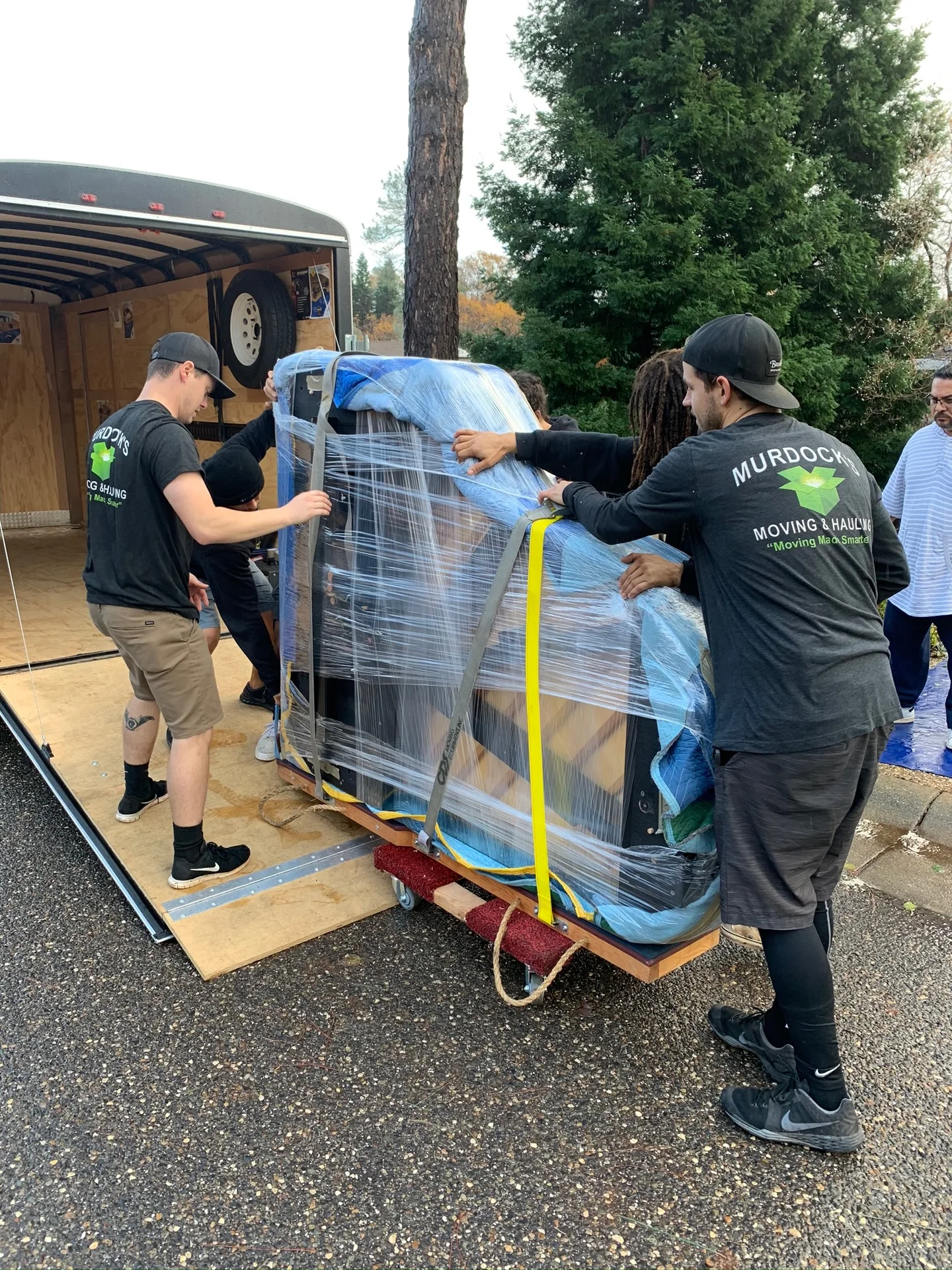
Most items in a household move follow a predictable pattern — box it, load it, unload it, unpack it. Pianos and safes break that pattern entirely. They’re not just heavy furniture; they’re dense, awkwardly balanced, often irreplaceable in either monetary or sentimental value, and capable of causing real injury or serious property damage if handled without the right equipment. After years of moving families throughout Chico, Yuba City, and the surrounding Sacramento Valley, these are consistently two of the items that generate the most questions — and the most worry — from customers planning a move.
Here’s what actually makes pianos and safes different from everything else on a moving truck, and what a homeowner should know before scheduling a move that includes either one.
Why Pianos Aren’t Just “Heavy Furniture”
An upright piano typically weighs somewhere between 300 and 500 pounds. A console or spinet piano runs a bit lighter, while a baby grand can weigh 500 to 700 pounds, and a full concert grand can push past 1,000. But weight is only part of the challenge — the bigger issue is balance and construction.
Uprights are top-heavy and narrow at the base. Tip one even slightly past its balance point without control, and it can fall fast, with enough force to injure anyone standing nearby or crack the case, damage the soundboard, or knock the action out of alignment.
Grand pianos have to be partially disassembled. The legs, pedal lyre, and sometimes the lid are removed before the piano body — still several hundred pounds of curved, irregularly shaped instrument — gets wrapped, secured to a piano board, and moved as a single unit. Reassembly on the other end has to be done correctly or the instrument won’t sit level, which affects both its structural stability and how it plays.
The internal mechanism is sensitive. A piano isn’t a solid block — it’s thousands of moving parts, tensioned strings, and a wooden soundboard that responds to how it’s tilted, jostled, and set back down. Rough handling can throw a piano out of tune immediately, and repeated jarring over a move can cause damage that isn’t obvious until weeks later.
This is why professional piano moving relies on specific equipment most households simply don’t have on hand: piano boards, four-wheel dollies built for concentrated weight, moving straps rated for the load, and — for stairs — either a stair-climbing dolly or a coordinated team that can control the piano’s descent step by step without ever letting its full weight rest on one person.
Why Safes Present a Completely Different Problem
If pianos are a balance problem, safes are a density problem. A home safe packs enormous weight into a small footprint — a mid-size residential gun safe or fire safe commonly weighs 300 to 800 pounds, and larger models or commercial-grade units can run well over 1,000 pounds, all packed into a box that might only be two or three feet on each side.
That combination — heavy, narrow, and often positioned in a closet, office corner, or basement — creates a few recurring challenges:
- Doorway and hallway clearance. A safe that fit through the door when the house was being built doesn’t always fit back out easily once furniture, trim, or flooring has been added over the years. Measuring the safe and every doorway, hallway turn, and stairwell it needs to pass through — before moving day — prevents a very expensive surprise.
- Floor load concerns. Concentrated weight on a single point can stress flooring, especially on upper floors or over unsupported spans. A moving crew experienced with safes will use load-spreading equipment rather than rolling a dolly with a thousand pounds on it across an unsupported section of subfloor.
- Tipping risk during transport. A safe’s narrow footprint relative to its height makes it prone to tipping if it shifts even slightly during the move. Proper strapping to a dedicated appliance dolly, plus careful ramp angles when loading into the truck, are what keep it upright.
- No natural handholds. Unlike furniture, a safe usually doesn’t offer a good grip point, which is exactly why professional movers use pry bars, safe skates, or hydraulic lift equipment for the heaviest units rather than relying on manual lifting.
What to Tell Your Mover Before the Job
Getting an accurate quote and the right equipment on the truck starts with giving your moving company complete information up front, not on moving day itself. For a piano or safe, that means sharing:
- Exact weight and dimensions, if known. A safe’s specs are usually printed on the interior door or in the manual; a piano’s weight can often be found from the manufacturer or estimated by type (upright, console, baby grand, grand).
- Current and new locations within each home, including which floor, how many stairs, and whether it’s currently against an exterior wall (grand pianos, in particular, are sometimes moved in through a window or removed door frame when a standard doorway won’t work).
- Any tight turns, narrow hallways, or low doorframes along the path the item has to travel.
- Whether the item needs to be disassembled — grand piano legs and lyre, or a safe that’s bolted to the floor.
This level of detail lets a mover staff the job correctly, bring the right equipment the first time, and give you a quote that reflects the actual difficulty rather than a generic furniture estimate. You can get a starting estimate for the rest of your move using our free moving estimate, then flag the piano or safe as a special item when you follow up for a full quote.
Why DIY Piano and Safe Moves Go Wrong So Often
It’s worth being direct about this: moving a piano or safe without the right equipment isn’t a matter of “it’ll probably be fine if we’re careful.” These are two of the most common sources of serious moving injuries — crushed fingers, back injuries, and worse when an item tips unexpectedly — and they’re also two of the most common sources of expensive property damage, from cracked stairs and gouged flooring to a piano that’s permanently out of alignment.
Renting a piano dolly or appliance dolly for a day and asking a few friends to help feels like a reasonable cost-saving move, but the equipment alone doesn’t solve the core problem, which is coordination and technique under load. A crew that moves pianos and safes regularly develops a feel for how the weight shifts, when to stop and reset, and how to communicate through a tricky stairwell turn — none of which comes automatically just because you rented the right dolly.
How This Fits Into Your Overall Move
A piano or safe rarely travels alone — it’s usually one part of a larger household or office relocation. When you’re planning a move that includes one of these specialty items, it helps to think of it as its own mini-project inside the bigger move: confirm the equipment and staffing needed for that one item specifically, rather than assuming your general moving quote automatically covers it.
This matters just as much for local moves across town in Chico as it does for a longer relocation. If your move is heading out of the immediate area, our long-distance moving services page covers how we plan transport and protection for high-value items over a longer haul, where extra time in transit means extra opportunities for something to shift if it wasn’t packed and secured correctly the first time.
And if your new home isn’t quite ready to receive a piano or safe — say, flooring is being finished or a dedicated room isn’t done — short-term storage solutions can hold the item safely in a climate-considered space rather than forcing an awkward two-step move.
What Murdock’s Moving & Storage Brings to a Specialty Item Move
Our crews handle pianos and safes as a routine part of residential and commercial moves throughout Chico, Yuba City, and the broader Sacramento Valley, and we bring the specific equipment each item calls for — piano boards, safe skates, appliance dollies rated for concentrated weight, and moving straps sized to the load — rather than treating a piano or safe like any other piece of furniture. We’re also fully licensed and insured under USDOT 3421940 / MC 1416634, which matters more on high-value items than almost anything else in a move, since it’s the coverage that protects you if something does go wrong.
If you have a piano, a safe, or another oversized or high-value item on your moving list, don’t leave it as an afterthought in your planning. Call Murdock’s Moving & Storage at (530) 354-8089 and tell us exactly what you’re moving — we’ll walk through the equipment, staffing, and timeline it needs so nothing about moving day catches you off guard.
RESEARCH CHECK
Sources & Helpful References.
These official resources support the time-sensitive or regulated details discussed in this guide. Information checked August 2026.
- FMCSA SAFER Company SnapshotOfficial federal carrier and safety-record lookup.
- California Bureau of Household Goods and ServicesCalifornia consumer information for household-goods movers.
- California household-mover permit searchSearch current California household-mover permit records.