Most businesses in the Sacramento Valley relocate because of a lease, not a plan. The landlord in Chico wants the suite back at the end of the month, the new building in Roseville is wrapping up its tenant improvements, or a Yuba City practice has simply run out of exam rooms. The date shows up first, and the planning gets squeezed in around it. That order is backwards, and it explains why so many office moves feel harder than they need to.
This guide is written for whoever has been handed the move: an office manager, a practice administrator, a facilities lead, or an owner who also does the books. It covers how to choose a date that fits the Valley’s calendars, how to divide the work between the movers and everyone else, what to ask when you compare commercial movers, and where on our site to find the detail for your type of business. Nothing here depends on hiring us. It will make any move go better.
Your Move Date Belongs to a Calendar You Already Know
Before thinking about trucks, write down the weeks your business cannot afford to spend in boxes. In this part of California those weeks are fairly predictable, because a handful of calendars drive most of the local economy.
- Harvest. Almonds come in from August into October, walnuts from September into November, rice in September and October, and peaches through the middle of summer. A packing shed, huller, ag lender or crop-insurance office in Butte, Sutter, Yuba or Colusa County should not be packing up its front office while trucks are lined up at the scale. Our packing shed office moving page explains how the gap between packing runs becomes the move window.
- The public fiscal year. State departments, counties, school districts and community colleges close their books on June 30. Purchasing often has to approve summer work in the spring, so a move that looks like an August job is really a March decision. State agency office moving shows how that plays out on department floors in downtown Sacramento.
- The school year. Public schools get the weeks between the final day of classes and teacher report days in August. Departments at Chico State, Sacramento State and Yuba College plan around finals and semester breaks. Public school moving walks through a summer move counted room by room.
- Tax season. An accounting office has no business relocating between January and April 15. Late spring into early summer is the natural window, which accounting and CPA office moving covers in detail.
- Heat. From June through September, heavy loading in the Valley is a morning job. That does not rule out a summer move, but it shapes the day. Crews start early, and anything that dislikes a hot truck box travels in an air-conditioned car instead.
Once the blackout weeks are on paper, the open weeks tend to reveal themselves. Choose a first-choice date and a fallback inside them, then plan backward from opening day at the new address.
Three Hubs, Three Kinds of Buildings
The Valley is not one commercial market. The building stock changes as you drive Highway 99, and so does the paperwork a landlord will ask for.
Chico and Butte County. Downtown and along the Esplanade, many offices sit in older two-story buildings with a staircase, street parking and a narrow back entrance. Medical suites cluster near Enloe, and newer business parks sit out by the municipal airport. Expect stairs and tight loading more often than freight elevators. Our Chico movers page covers the local ground in more depth.
Yuba City, Marysville and Sutter County. Professional offices along Colusa Avenue and Garden Highway are mostly single-story with shared lots, while ag and industrial buildings ring both towns. Access is usually simpler here. The calendar is usually tighter, because so many local businesses answer to the harvest. See Yuba City movers for the area we cover.
Sacramento, Roseville and Rocklin. Towers on Capitol Mall and J Street book freight elevators by the hour and assign loading dock slots. State departments lease whole floors downtown, with more offices in Natomas and at McClellan Park. The Roseville and Rocklin office campuses off Highway 65 and Blue Oaks Boulevard often keep move work out of business hours entirely. Start with Sacramento movers or Roseville movers for those markets.
We work from hubs in Chico, Yuba City and Sacramento, and Roseville, Rocklin and the rest of Placer County are covered from the Sacramento side. Wherever your building is, ask for its move-in rules the same week the lease is signed. Larger buildings commonly require a certificate of insurance before a mover can enter, and waiting on that document is a common reason a date slips. We issue a certificate on request, listing the building owner and property manager the way their packet asks.
Write Down Who Handles What
A business relocation involves more people than the moving crew, and the moves that go sideways are usually the ones where a task fell between two of them. The fix is a plain responsibility list: every category of item, with a name beside it.
Here is how that list tends to divide on our jobs:
- Our crew packs and carries furniture, casework that is not plumbed in, file cabinets, shelving, cartons, pallets of boxed goods and the break room. At each desk, the crew unplugs the computer and monitors, pads them and plugs them back in at the new station.
- Your IT contact owns the network, servers, phone system, logins and the first-morning check. IT workstation moves describes exactly where our part stops and theirs begins.
- Equipment vendors handle anything calibrated or covered by a service contract, such as dental chairs, x-ray units, lab analyzers and register systems. The dental office moving page is a good example of a practice where the vendor’s schedule sets ours.
- Licensed trades disconnect and reconnect anything tied to water, gas, refrigeration or building power. In a restaurant, that covers most of the kitchen, and restaurant moving explains how our crew fits around their visits.
- Installers and equipment contractors take down floor-anchored racking, production lines and heavy machinery. Warehouse moving covers the dock-to-dock side of that division.
- Your own staff keep control of anything that should never leave their hands: patient records, original documents, controlled substances, cash, keys, and licensed inventory such as wine and beer.
If a mover quoting your job cannot tell you, item by item, which of these lines they sit on, keep asking until they can. A vague answer here becomes a surprise on moving day.
Pick the Shape of the Move
Commercial moves come in three basic shapes, and choosing one early changes everything that follows.
All at once. Staff work in the old space through the last day, the move happens over an evening or a weekend, and the new space opens the next business morning. This suits most small and mid-sized offices, clinics and shops. Evening and weekend moves are available on request, provided each building will let a crew in during those hours.
In waves. Larger offices, or any organization that cannot stop everything at once, move department by department over several weeks. That takes swing space, a lease overlap and careful sequencing so nobody is left without a desk. Phased office moves lays out how the waves get planned and spaced.
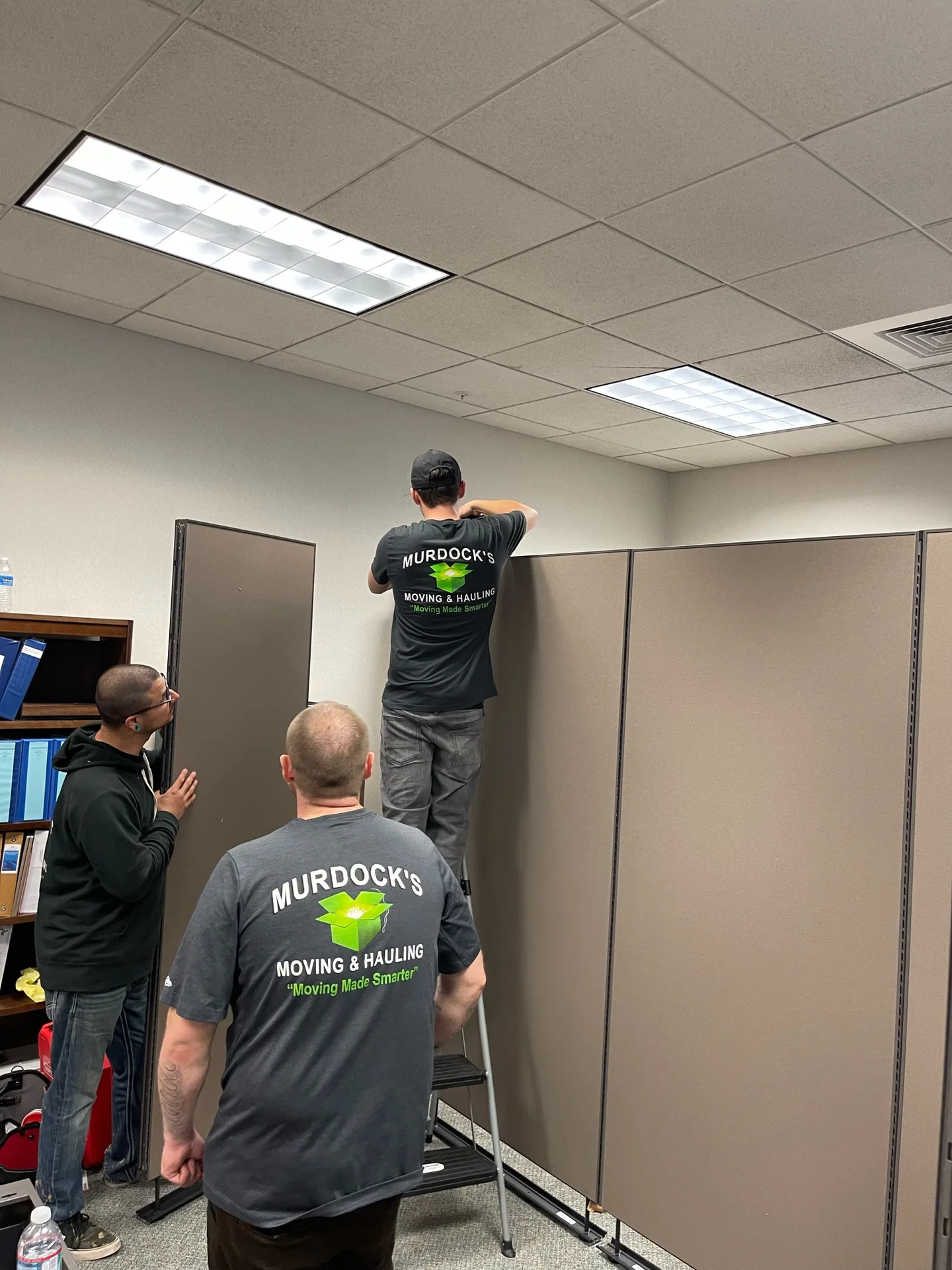
Rebuilding the floor. Sometimes the real work is the workstations themselves: panel systems that have to come apart at one address and go back together, often in a new layout, at the other. Cubicle disassembly and reassembly describes how stations are taken down in a written order, moved and rebuilt to your new plan, with a licensed electrician handling the power connections.
Whatever shape you choose, the first morning matters more than the last night. Decide which rooms and which people have to be working when the doors open, and make sure those are loaded last so they come off the truck first.
A Workable Planning Timeline
For a typical office or practice, the order of operations below holds up well. Public agencies, schools and larger organizations should add time at the front end for purchasing.
- The week the lease is signed. Request move-in rules from both buildings, list your blackout weeks and name one person inside the business as the move lead.
- Six to eight weeks out. Schedule walkthroughs, collect written quotes and book your IT contact, equipment vendors and any trades.
- About a month out. Confirm the date, send in the certificate of insurance, reserve elevators and docks, and finish the floor plan with a code for every room.
- Two weeks out. Start packing archive files, supply rooms and anything that is not used every day. Mark items for shredding, donation or storage.
- The final week. Staff pack their own desks, IT backs up and labels equipment, and the crew confirms arrival times and building access.
- The first morning. Reception and priority stations come up first, then everything else. Keep a short list of fixes for the crew or the vendors while everyone is still close by.
If your business wants help boxing things up, our packing services can take the supply rooms and archive runs off your staff’s plate while they keep working.
Questions to Ask Any Commercial Mover
Whether you call us or another company, these questions separate a genuine commercial plan from a household move with a bigger truck.
- Will someone walk both buildings before quoting? A phone estimate cannot see the stairwell, the dock height or the lobby’s rules.
- Can you send a certificate of insurance in our building’s required wording? Ask early, because some property managers will not confirm a date until they have it.
- How will each piece find its room? Look for labeling tied to a floor plan, with room codes or seat numbers that match tags on the doors at the new site.
- Who reconnects the computers, and where does that job end? You want a clear answer that leaves the network with your IT contact.
- What happens to things with no home yet? Surplus furniture, closed files and off-season fixtures need a plan, whether that means donation, disposal or storage.
- Is the quote written and itemized? Schools, agencies and many larger businesses need line items they can attach to a purchase order.
- What will you not do? A trustworthy mover names the work that belongs to vendors and trades instead of promising to take care of everything.
On the fifth question: Murdock’s offers short- and long-term warehouse storage at our Chico and Yuba City yards, as well as MODS portable storage containers. If part of the old office has nowhere to go on move day, mention it when you request the estimate.
Find the Pages for Your Kind of Business
Our commercial moving hub sorts the work into six groups, because the plan for a dental suite has almost nothing in common with the plan for a distribution floor.
- Business and professional offices covers law, accounting, insurance, ag lending and brokerage offices, where deadlines and file rooms drive the schedule.
- Healthcare and medical covers dental, medical, therapy and veterinary practices, where the equipment vendor’s visit anchors the weekend.
- Education, civic and community covers schools, college departments, churches, libraries and nonprofits working inside academic calendars and purchase orders.
- Retail, restaurant and hospitality covers shops, restaurants, taprooms, tasting rooms and salons that have to move inside a landlord’s window.
- Property, institutional and government covers state and county offices, property managers, HOAs and senior communities, where sign-offs and building security set the pace.
- Warehouse, ag and light industrial covers warehouse offices, packing sheds, processors and shops, planned from one dock to the other around the crop.
If you would rather start from the task than the industry, the commercial services index lists each type of work, from records and store fixtures to full-building relocations. And if you run an ordinary office suite with no special equipment, our office moving page is the most direct place to begin.
Talk Through Your Move With Us
We begin every commercial job by walking the space with you and putting the plan in writing. Bring your target date, your building’s rules and your responsibility list, and we will fill in our part of it. You can request a moving estimate online, or call Murdock’s Moving & Storage at (530) 354-8089 to set up a walkthrough in Chico, Yuba City, Sacramento, Roseville or anywhere in between.
RESEARCH CHECK
Sources & Helpful References.
These official resources support the time-sensitive or regulated details discussed in this guide. Information checked August 2026.
- IRS Topic 455: Moving ExpensesCurrent federal guidance for eligible military and intelligence-community moving expenses.
- IRS Form 3903 instructionsEligibility and documentation details for the moving-expense deduction.
- FMCSA SAFER Company SnapshotOfficial federal carrier and safety-record lookup.
- California Bureau of Household Goods and ServicesCalifornia consumer information for household-goods movers.
- California household-mover permit searchSearch current California household-mover permit records.
- National Weather Service heat safetyHeat-risk and heat-illness prevention guidance.